In pharmaceuticals, speed to market is often discussed as a downstream challenge – faster trials, quicker approvals, accelerated scale-up. Yet, in practice, many of the delays that slow products down are already locked in long before any of those stages begin. They are created quietly, early, and unintentionally – at the point of formulation design.
Over the last decade, the industry has learned an important lesson: while APIs define therapeutic intent, formulation decisions define development velocity. As pipelines grow more competitive and healthcare systems demand faster access without compromising quality, the real race is increasingly being won upstream.
This is where co-processed excipients have emerged as a powerful, and often underestimated, enabler of speed.
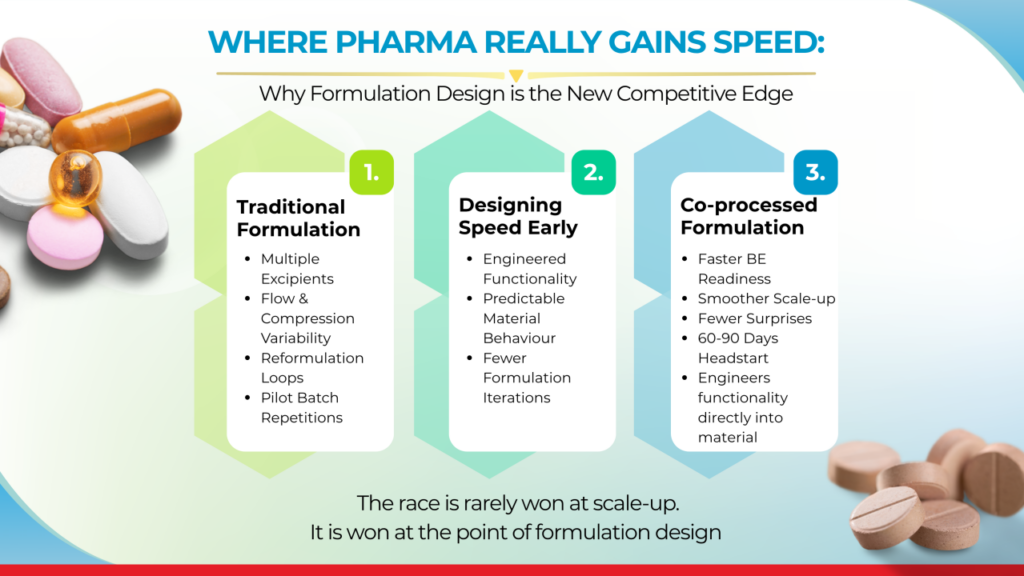
Traditional formulation development has long involved balancing trade-offs. Improving flow could compromise compressibility. Enhancing tablet strength might affect dissolution. Addressing one performance parameter often introduced instability elsewhere, leading to reformulation cycles, additional pilot batches, and extended development timelines.
Industry studies suggest that nearly 60% of formulation-related delays in solid oral dosage development stem from such downstream corrections rather than API-related issues.
Co-processed excipients were developed to address exactly this fragmentation. Rather than blending individual excipients and hoping for uniform behaviour, co-processing engineers functionality directly into the material – combining flowability, compressibility, dilution potential, and mechanical robustness into a single, predictable system.
The result is not a new chemical entity, but a functionally integrated platform that behaves consistently across batches and scales.
This distinction matters, particularly as direct compression now accounts for an estimated 70% of global solid oral dosage manufacturing. In high-speed compression environments, even minor variability in particle size distribution, bulk density, or deformation behaviour can cascade into weight variation, hardness drift, or dissolution failure.
Co-processed excipients reduce these risks by design, allowing formulation teams to progress with greater confidence and fewer iterations.
From a development perspective, the impact is tangible. Fewer reformulation loops mean fewer pilot batches. More predictable compression behaviour means faster readiness for bioequivalence studies. More stable performance across equipment and scales means smoother technology transfer. Collectively, these advantages can translate into a 60–90 day head start – not by accelerating later stages, but by removing friction at the very beginning.
Market adoption reflects this reality. The global co-processed excipients market, currently estimated at USD 1.5–2.0 billion, is growing at a 7–9% CAGR, outpacing traditional excipient growth. Importantly, this adoption is no longer limited to niche or differentiated products. Generic manufacturers are increasingly using co-processed systems to improve robustness, reduce development risk, and strengthen regulatory confidence.
Regulatory acceptance has matured alongside this growth. Global agencies such as the US FDA and EMA recognise co-processed excipients as functional systems when their components are pharmacopeial and well characterised. This has reduced uncertainty while simultaneously raising expectations around functional justification, lifecycle performance, and risk assessment – areas where engineered excipient systems often perform better than simple blends.
From a CEO’s perspective, the relevance of co-processed innovation extends well beyond formulation science. It directly influences portfolio velocity, capital efficiency, and organisational focus. Faster formulation readiness allows R&D teams to allocate time to innovation rather than troubleshooting. Predictable scale-up reduces manufacturing surprises. Earlier and more reliable filings improve launch confidence in crowded markets.
There is also a sustainability dimension that cannot be ignored. By reducing processing steps, rework, and batch failures, co-processed excipients contribute to lower energy consumption, reduced material waste, and improved first-time-right outcomes. As ESG expectations tighten globally, operational efficiency and environmental responsibility are increasingly converging – and formulation design plays a central role in that convergence.
India, as one of the world’s largest producers of solid oral dosage forms, stands at a particularly important intersection of these trends. The next phase of India’s pharmaceutical leadership will not be defined by volume alone, but by how efficiently and reliably products move from concept to patient. Co-processed excipients offer a pathway to do exactly that – enabling speed without sacrificing quality, compliance, or trust.
Ultimately, the greatest advantage will belong to organisations that view co-processed excipients not as catalogue products, but as collaborative tools. Speed to market is maximised when excipient suppliers, formulators, quality teams, and manufacturing leaders engage early – aligning material science with process design and regulatory strategy from the outset.
The future of pharmaceutical competition will not be decided solely by who discovers faster, but by who designs smarter.
In an environment where timelines are shrinking and expectations rising, co-processed innovation represents a quiet but decisive shift – moving speed to market upstream, where it belongs.